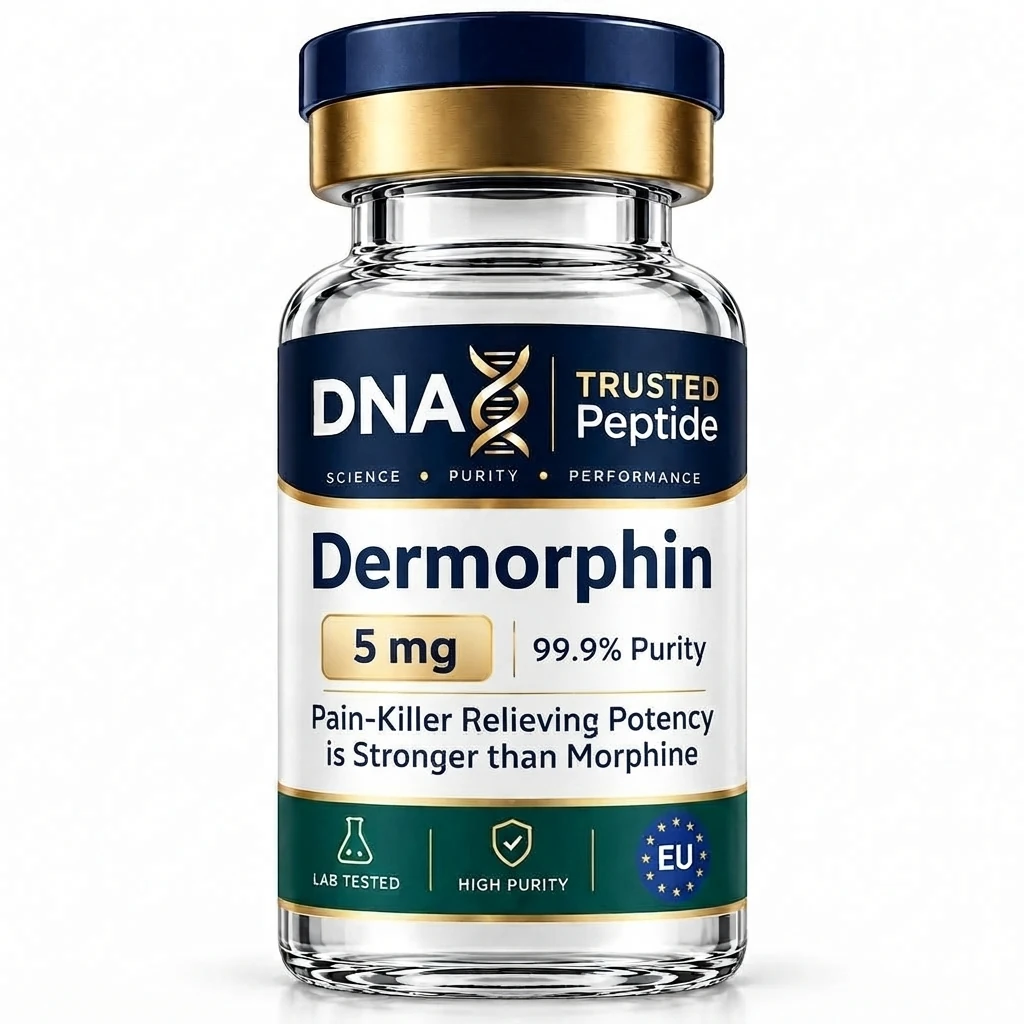

Dermorphin
A potent natural opioid peptide with high affinity for μ-opioid receptors, providing deep pain relief many times stronger than morphine.
Dermorphin is a natural opioid heptapeptide originally isolated from the skin secretions of the South American tree frog (Phyllomedusa sauvagei). It has a unique structure containing the amino acid D-alanine at position 2 — an exceptional post-translational chemical modification that gives it near-complete resistance to breakdown by intestinal and tissue proteases, greatly increasing its biological stability. Dermorphin acts as a very potent, selective agonist of mu-opioid receptors (MOR) in the central and peripheral nervous systems; its affinity and pain-relieving power exceed those of morphine by about 30–40 times, and it shows differing rates of tolerance, dependence and respiratory depression in laboratory and pharmacological models.
The exceptional natural painkiller derived from tropical nature, with potency many times that of morphine
If traditional opioid painkillers need escalating doses and cause rapid build-up of tolerance and side effects, Dermorphin is the most intriguing biological model in the chemistry of neuropeptides and the relief of intractable pain.
Classification: Highly analgesic opioid peptides, selective mu-opioid receptor agonists, modulation of neural pain signals (Opioid Peptides / Mu-Opioid Receptor Agonists / Analgesic Peptides).
Structurally, it consists of 7 amino acids including D-alanine, which is rare in higher organisms. This stereo-inversion of the amino acid acts as a shield that stops digestive enzymes breaking the peptide bond, giving it a longer biological life and a greater ability to reach nerve receptors without losing its active shape.
Picture acute or chronic pain signals as a huge electrical current flowing through the dorsal horn of the spinal cord towards the brain. It needs a very tight molecular switch that closes the neural gates immediately, without the need for large doses that affect the body's vital functions.
How it works
Dermorphin binds with high selectivity to mu-opioid receptors (MOR) spread through the sensory pathways of the spinal cord and the pain-perception centres of the brain. This binding inhibits voltage-dependent calcium channels in presynaptic nerve endings and opens potassium channels in postsynaptic cells, causing membrane hyperpolarisation that stops cells releasing pain-promoting transmitters such as substance P and glutamate. The result is immediate, deep relief of visceral and surgical pain at tiny fractions of a gram compared with traditional painkillers, making it the subject of in-depth studies aimed at designing new analgesic analogues with a lower risk of physical dependence.
In research, Dermorphin is used as a reference compound for calibrating opioid pain receptors, studying the physiology of addiction and neural tolerance, and developing hybrid painkillers able to relieve cancer pain and pain after major surgery more safely.
Controlling severe pain does not depend on increasing the amount of painkillers, but on designing precise molecules that find their way to the lock of pain without interfering with the rest of the nervous system.
Exceptional pain-relieving power drawn from nature to control the most severe pain. Dermorphin is an exceptional opioid compound derived from the chemistry of living organisms for studying pain relief with great molecular precision. It belongs to the class of analgesic neuropeptides and mu-opioid receptor agonists. Its unique structure of seven amino acids contains a rare structural protection that makes it resistant to rapid enzymatic breakdown, binding pain receptors in the brain and spinal cord with a strength about forty times that of traditional morphine. Its mechanism stops the flow of pain-carrying nerve signals immediately by closing calcium channels and curbing the release of pain-promoting compounds, giving a deep analgesic effect at very small microgram doses. Neuroscientists and toxicologists study it as a unique research tool for understanding the chemistry of pain and developing new generations of powerful painkillers with fewer side effects — because controlling acute pain begins by understanding the complex chemical messages that stop the sensation of pain at its source.