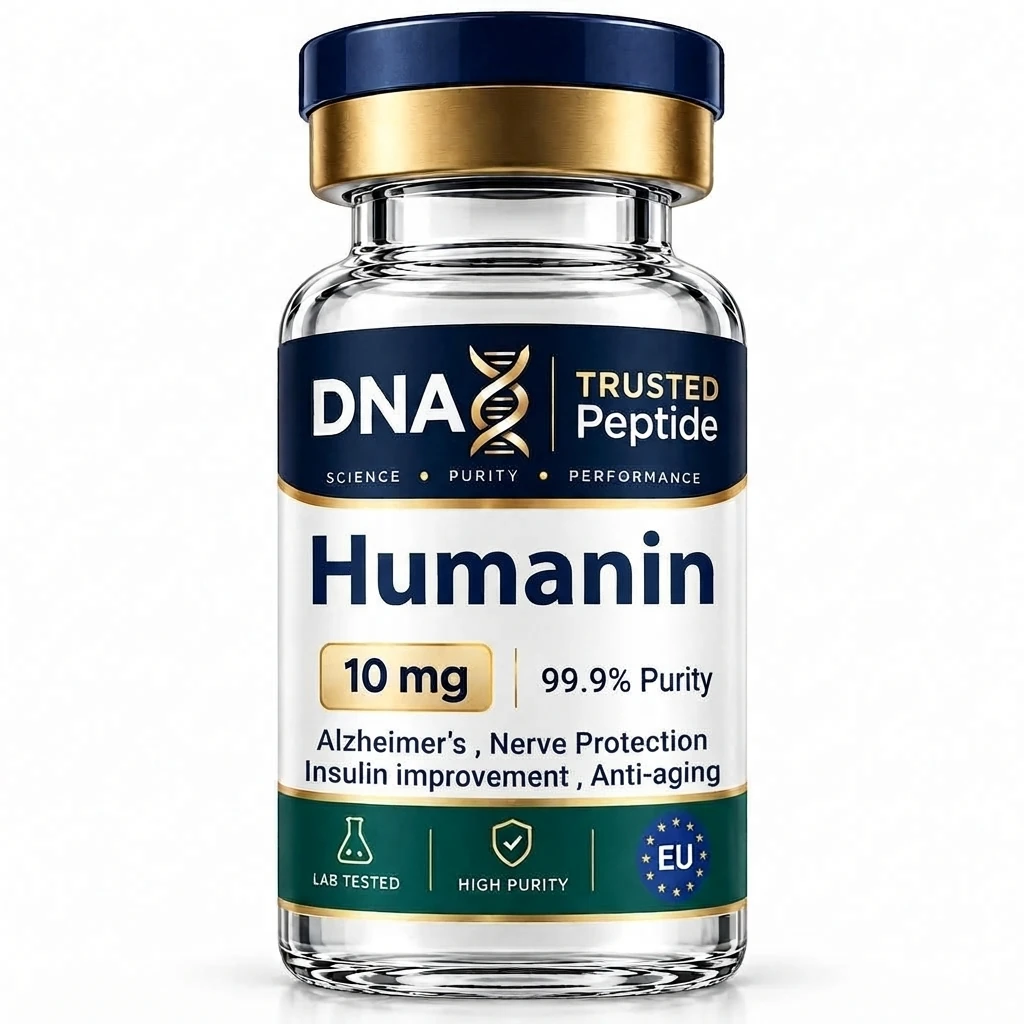

Humanin
A mitochondria-derived peptide that protects neurons from Alzheimer's-related toxicity, reduces insulin resistance and extends cellular lifespan through several protective cellular mechanisms.
Humanin (HN) is a small mitochondrial-derived peptide (MDP) of 24 amino acids with the natural sequence Met-Ala-Pro-Arg-Gly-Phe-Ser-Cys-Leu-Leu-Leu-Leu-Thr-Ser-Glu-Ile-Asp-Leu-Pro-Val-Lys-Arg-Arg-Ala. It is encoded by a short open reading frame within the 16S ribosomal RNA gene (16S rRNA) of mitochondrial DNA (mtDNA). Humanin acts as a mitochondrial cytokine signal (mitokine) released to protect cells from stress, working through two distinct molecular pathways. Intracellularly, it binds the pro-apoptotic protein Bax directly, preventing it from moving to the outer mitochondrial membrane and inhibiting the release of cytochrome c. Extracellularly, it binds several membrane receptors, including a tripartite complex (gp130 / WSX-1 / CNTFR) and the formyl peptide receptor-like 1 (FPRL-1 / FPR2). Activating these receptors triggers the STAT3, ERK and AKT cell-survival pathways, suppressing amyloid-beta (Aβ)-induced neurotoxicity, reducing oxidative stress and vascular inflammation, improving peripheral insulin sensitivity, and protecting the vascular lining and heart-muscle cells from ischaemic damage.
The innate mitochondrial signal for neuroprotection, countering cellular ageing and improving metabolism
If you are looking for the body's natural mitochondrial line of defence to protect brain cells from degeneration and dementia, support the flexibility of blood vessels and the heart, and maintain insulin sensitivity with age, Humanin is the most influential molecular message that the cell's power plants send out to rescue tissue from death and inflammation.
Classification: Mitochondria-derived peptides, neuroprotective and cardioprotective factors, metabolic regulation and anti-ageing (Mitochondrial-Derived Peptides / Mitokines / Neuroprotective & Cytoprotective Peptides).
Structurally, it is a mitochondrially encoded peptide of 24 amino acids with flexible biochemical properties that let it work inside the cytoplasm to prevent breakdown of the mitochondrial membrane, or leave the cell and enter the systemic circulation to bind cell-surface survival receptors.
Picture the mitochondria as smart generators inside every cell that sense danger, oxidative stress and the build-up of misfolded proteins before anything else. When they detect that the cell is close to damage, they send out Humanin as an emergency signal that closes the self-destruction pathways and prevents the cell from dying.
How it works
Humanin acts as a protective shield on several levels. Inside nerve cells, it binds the apoptosis protein Bax directly, stopping it from puncturing the mitochondrial membrane and keeping energy (ATP) production going so that neurons survive even under the toxic amyloid-beta proteins linked to Alzheimer's disease. On the outer surface of cells, Humanin binds gp130 and FPRL-1 receptors, activating STAT3 cascades that dampen the release of inflammatory cytokines and reduce free radicals. This broad effect protects the cells lining blood vessels from hardening, reduces the area of ischaemic damage in the heart muscle, and counters the death of pancreatic beta cells while raising muscle and liver sensitivity to insulin. It also protects sperm and testicular cells from damage caused by stress and by thermal or chemical strain.
In research, Humanin and its highly potent synthetic analogues (such as HNG) are studied as one of the most important areas of regenerative medicine for treating Alzheimer's disease, cerebrovascular disorders, atherosclerosis and type 2 diabetes, and Humanin is also regarded as a biomarker of resistance to ageing and healthy longevity.
Protecting vital tissues from decline does not require shutting down body functions — it rests on strengthening the innate mitochondrial language that protects cells from internal damage and restores metabolic balance.
The vital guardian of the mitochondria for protecting the brain, renewing cellular energy and countering degeneration. Humanin is an exceptional discovery in mitochondrial science and cell-survival medicine for protecting vital organs from ageing and damage. It belongs to the class of mitochondria-derived peptides that protect the nerves and heart and improve metabolic sensitivity. Its unique structure comes from an original mitochondrial genetic code that cells release to defend themselves against tension and severe oxidative stress, acting as a shield that prevents cell self-destruction and neutralises the toxic proteins that accumulate in the nervous system. Its comprehensive mechanism supports memory and cognitive function, protects the lining of the coronary arteries, reduces deep cellular inflammation, improves the use of blood sugar and preserves the vitality of musculoskeletal and reproductive tissue. Pioneers of anti-ageing and neurological medicine study it as a promising cornerstone for treating degenerative diseases and extending healthy biological lifespan with the highest natural biocompatibility — because lasting youth begins by enabling the cell's energy generators to protect themselves and keep working efficiently and safely.