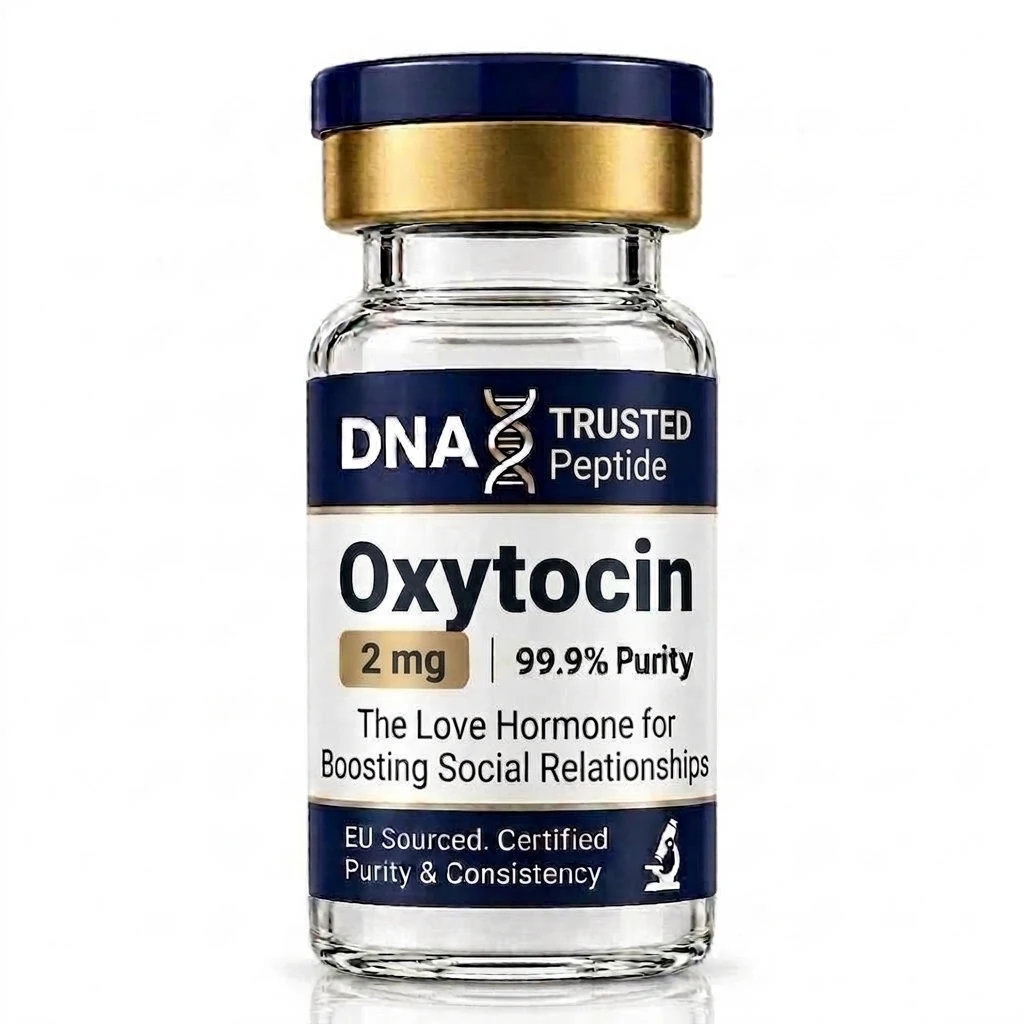

Oxytocin
A nonapeptide hormone, studied in social-bonding, mood and neuroendocrine research.
Oxytocin is an endogenous neuropeptide hormone of nine amino acids (nonapeptide) with the specific sequence Cys-Tyr-Ile-Gln-Asn-Cys-Pro-Leu-Gly-NH2. It has a six-membered ring formed by a disulfide bridge between the cysteine residues at positions 1 and 6, a flexible tripeptide tail and an amidated C-terminus. It is synthesised in the paraventricular nucleus (PVN) and supraoptic nucleus (SON) of the hypothalamus and transported along nerve axons to the posterior pituitary, from where it is released into the bloodstream as a systemic response — or released locally within central nervous system centres (the limbic system, amygdala and nucleus accumbens). Oxytocin acts through high-affinity binding to the oxytocin receptor (OXTR), a Gq/11-coupled receptor whose activation triggers the phospholipase C (PLC), inositol trisphosphate (IP3) and diacylglycerol (DAG) pathway, raising free intracellular calcium and activating protein kinase C (PKC). Physiologically, it stimulates contraction of uterine smooth muscle during labour and of myoepithelial cells in the mammary glands for milk let-down. Centrally, it acts as a high-level neuromodulator that calms amygdala over-activity, lowers cortisol and HPA-axis stress responses and enhances dopamine and serotonin release to strengthen social bonds, empathy and trust, soothe social anxiety and modulate pain perception.
The innate neuroregulator for building social bonds, lowering stress and cortisol and calming the nervous system
If you want to restore inner calm, quiet anxiety and social tension, and strengthen feelings of trust and positive emotional connection — while lowering the chronic stress hormone cortisol and supporting physiological and muscular balance — Oxytocin is the leading innate molecule the body designed to establish calm, safety and human connection.
Classification: Emotion-regulating neuropeptides, OXTR agonists, stress and cortisol reduction and social bonding (Neuropeptides / OXTR Agonists / Social Bonding & Anxiolytic Agents).
Structurally, it is a compact nonapeptide containing a six-membered ring closed by a disulfide bond, with a flexible tail and amidated end. This molecular design gives it strong, rapid binding to oxytocin receptors spread deep in the brain's emotional centres and in muscle and heart tissue.
Picture the emotional control centre of your brain under pressure as an operations room where the alarm (the amygdala) keeps sounding cries of fear and alertness. Oxytocin is the decisive voice of reassurance that enters the room and switches the sirens off at once, slowing the heartbeat and giving cells a sense of complete safety and rest.
How it works
Oxytocin binds OXTR receptors in the limbic system and amygdala, damping over-excited neurons in the amygdala and producing an immediate, direct reduction in anxiety, fear and social phobia. At the same time, it acts on the hypothalamic-pituitary-adrenal (HPA) axis to restrain cortisol release, reducing the toxic effects of chronic stress on brain cells and blood vessels. It also activates dopamine reward pathways in the nucleus accumbens, deepening feelings of emotional belonging and harmony and strengthening intimate relationships and mutual trust. Physically, it coordinates smooth-muscle contraction and supports heart health by stimulating nitric-oxide release in the vascular lining to calm blood pressure and ease chronic pain — creating an overall state of mental and physical relaxation.
In clinical and research settings, oxytocin is widely used in obstetrics to support natural labour and prevent post-partum haemorrhage, and its analogues and nasal and neural applications are being studied with great interest as advanced tools for autism-spectrum conditions, severe social anxiety, post-traumatic stress disorder (PTSD) and improving emotional and physical quality of life, with excellent biocompatibility.
Finding peace of mind and recovering from life's pressures does not require drugs that dull the emotions — it rests on awakening the innate neural signal the body created to generate safety, affection and inner rest.
The innate neural messenger for calming anxiety, strengthening trust and bonding and lowering the stress hormone. Oxytocin is the supreme biological molecule in the human body for creating inner calm and building bridges of emotional connection and safety. It belongs to the class of calming neuropeptides and oxytocin-receptor agonists that support psychological and social balance and soothe neural tension. Its precise nine-amino-acid structure binds directly to the safety receptors in the amygdala and emotional control centres, acting as a natural calmer that restrains fear and social phobia and reduces tissue-damaging cortisol. Its unique mechanism stimulates rest and dopamine pathways to deepen relaxation and belonging, while regulating vascular flexibility, easing physical pain and coordinating smooth-muscle function with excellent biocompatibility. Leading neuroscientists study it as a powerful natural compound for emotional resilience and restoring inner stability of mind and body without mental dulling — because real rest comes from enabling your brain to release the original code of reassurance that restores balance and inner peace from the source.